kfm.co.ug
@kfm Wed, 08 May 2024 06:26:17
Traders vow to close businesses again over sticking issues about EFRIS
By Barbra Anyait editorial@ug.nationmedia.com A section of dissatisfied traders has vowed to close their businesses again over what they call unfair implementation of the Electronic Fiscal Receipting and Invoicing system (EFRIS) by Uganda Revenue Authority (URA). This follows their much-anticipated meeting with president Museveni yesterday at Kololo Independence Grounds, during which many had hoped to have their grievances addressed. Some of the concerns they had earlier raised included corruption allegations against URA officials, over and double taxation, among others. Specifically, the chairperson of the Federation of Uganda Traders’ Association (FUTA), Mr. John Kabanda decried the high and unfavourable taxes imposed on them by URA. However, the president said he did not see any form of double taxation as claimed by […]
read morematookerepublic.com
@matookerepublic Wed, 08 May 2024 06:23:55
Phoebe Nekesa to represent Uganda at Top Model of the World Pageant in Egypt
The second runner-up for Top Model Uganda, Phoebe Nekesa, aged 21, is set to represent Uganda at the Top Model of the World Pageant in Hurghada, Egypt, this Sunday. The Ugandan queen, who is also a poet and podcaster, will be joining 44 other beauties from across the world on the global stage for this […]
The post Phoebe Nekesa to represent Uganda at Top Model of the World Pageant in Egypt appeared first on Matooke Republic.
read more





observer.ug
@observer Wed, 08 May 2024 05:58:04
Why Among needs to carry lots of cash

We can’t predict when — or if — the sanctions will come but when they do, the timing and tone of the announcement deliver a hefty dose of unexpected drama and tension.
First, it was the towering former Police chief General Kale Kayihura who got flat-felled in 2019. And in December 2021, Maj Gen Abel Kandiho, head of the Chieftaincy of Military Intelligence (CMI), was sanctioned by the USA Department of the Treasury’s Office of Foreign Assets Control (OFAC) together with high-profile Iranian and Syrian officials for serious human rights abuse and repressive acts targeting innocent civilians, political opponents and peaceful protestors.
And now the UK recently imposed sanctions on three Ugandan officials— Anita Among, Speaker of parliament, and former ministers Gorreti Kitutu and Agnes Nandutu—accused of embezzling funds intended for impoverished communities in Karamoja, specifically involving an iron sheet scandal.
These sanctions, announced by the UK’s Foreign, Commonwealth and Development Office, mark the first application of the UK’s Global Anti-Corruption Sanctions regime against individuals linked to corruption in Uganda. Among had been implicated in diverting iron sheets meant for Karamoja, though she returned the 500 pieces she was accused of misappropriation but was not formally charged.
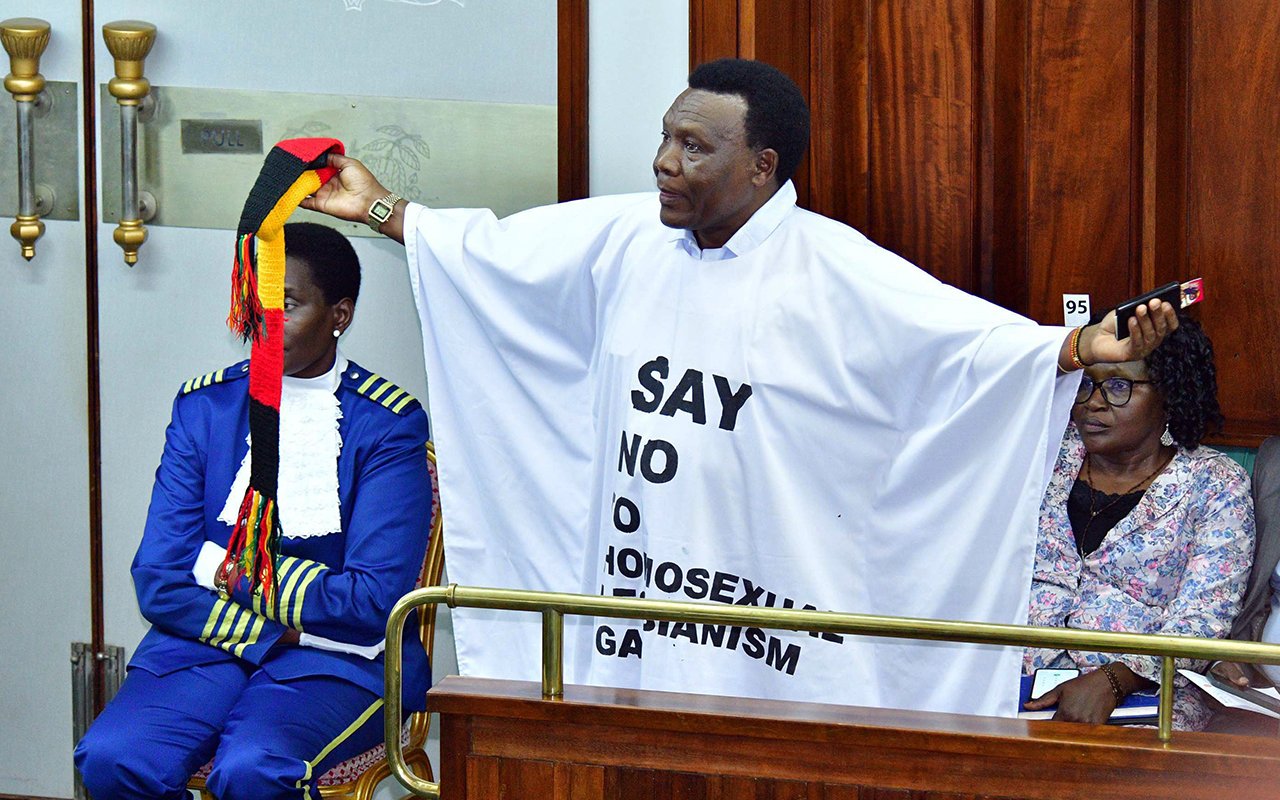
Parliamentary spokesperson, Chris Obore, suggested in a statement issued on April 30, that the sanctions might be influenced not just by the corruption allegations but also by her support for the Anti-Homosexuality Act of 2023, highlighting a potentially complex political backdrop to the sanctions.
Days later, Among stated that she was punished for presiding over the passage of the internationally condemned Anti- Homosexuality Act.
The sanctions against Among and the two former ministers include travel and asset freezes. Asset freezes prohibit any UK citizen or business from dealing with the assets of the sanctioned individuals if located in the UK. This action is part of a broader effort by the UK to combat serious global corruption, signaling a clear message against the misuse of power for personal gain.
The implications of these sanctions extend beyond the immediate legal and economic consequences for the individuals involved. Among’s responses have highlighted her limited grasp of the wider ramifications of the sanctions. She has derided the sanctions, stating that she doesn’t even own a pet cat in the UK. She has further urged the authorities there to proceed with freezing her assets.
“These sanctions are politically motivated. I am carrying a cross for the ‘48 million’ Ugandans.” Among insists that UK sanctions imposed on her for allegedly being corrupt are because of her support for the anti-homosexuality law.
On the surface, a sanctioned individual is barred entry into the UK, and any assets he or she owns there are frozen. But broadly, the imposition of sanctions by the UK could prompt other nations, particularly allies such as Australia, Canada, the USA and EU member states, to impose similar travel and cash restrictions.
These countries often coordinate or follow suit with their allies’ sanctions, especially when they pertain to corruption and human rights violations. Sanctioned individuals may encounter growing challenges in conducting financial transactions both internationally and domestically, particularly in cashless transactions.
According to expert sources familiar with sanctions and their far-reaching implications, the UK sanctions could severely impact individuals in several ways.
Asset freezes: The direct impact of the sanctions includes freezing of assets held within the jurisdiction enforcing the sanctions—in this case, the UK. However, the influence of the UK in global finance means that these sanctions could extend to freezing assets held in international accounts, particularly in allied countries.
This would prevent the sanctioned individuals such as Among from accessing any funds or economic resources they own or control within these territories.
Banking and financial services: Banks and financial institutions in the EU, USA, and other allied nations generally comply with international sanctions to avoid penalties and preserve their reputational integrity. As a result, the sanctioned individuals might face difficulties in accessing banking services, securing loans, or carrying out international financial transactions.

SWIFT SYSTEM
If the UK and allies decide to get the sanctioned officials off the global SWIFT system, that could seriously cripple their ability to transact both internationally and locally in the financial system.
SWIFT, or the Society for Worldwide Interbank Financial Telecommunication, is a global messaging network used by banks and other financial institutions to securely transmit information and instructions through a standardized system of codes. Established in 1973, SWIFT facilitates the rapid and secure exchange of financial messages concerning payments, securities, trade transactions and treasury operations among its members.
SWIFT does not handle the transfer of funds itself but provides the communication infrastructure to send payment orders that need to be settled by correspondent accounts that institutions have with each other. Each financial institution on the network is assigned a unique code known as a SWIFT code or Bank Identifier Code (BIC), which is used to send money across borders efficiently.
SWIFT is crucial for international finance because it ensures the fast, accurate and secure communication necessary for completing cross-border transactions. It connects over 11,000 financial institutions in more than 200 countries and territories, making it one of the leading networks for international financial messaging.
If the UK uses its influence on the SWIFT system, that could seriously affect the sanctioned individuals, such as Among and her colleagues.
Here’s how:
Blocking financial transactions: SWIFT facilitates the majority of global banking communication. If the UK decides to leverage its position to influence SWIFT operations regarding sanctioned individuals, it could effectively block or monitor the financial transactions of those individuals.
By restricting their access to SWIFT, the UK can prevent Anita Among and others from conducting international financial transfers, which would severely limit their ability to operate globally.
Isolation from international banking: Being cut off from SWIFT would mean that banks worldwide that comply with these sanctions would not process transactions involving the sanctioned individuals. This isolation from the international financial system complicates any attempts to move, access, or utilize funds stored in foreign banks, essentially crippling the individual’s financial mobility.
Increased scrutiny by financial institutions: Banks and financial institutions often use SWIFT messages to conduct due diligence. If the system flags individuals as sanctioned, banks are likely to conduct enhanced scrutiny on any transactions associated with them, further limiting their ability to engage in financial activities.
In the specific case of Anita Among, her role as a high-profile political figure could mean that her financial activities are more likely to be international in scope, involving significant transactions. UK’s influence on SWIFT could effectively ensure that she faces substantial hurdles in accessing international financial markets, thereby amplifying the impact of the travel bans and asset freezes.
EXPERT ANALYSIS
Fred Muhumuza, an economist, stated that the sanctions imposed on the speaker of parliament, Anita Among and two former ministers, do not affect banks, as they target an individual rather than the entire country, unlike the cases of Russia and Iran. Locally, Dr Muhumuza noted that the speaker might not be significantly affected because SWIFT operates country-to-country and institution-to-institution.
Only UK banks are required to comply with the sanctions, meaning her assets and financial transactions in Uganda or other countries like America are unlikely to be affected unless those nations also decide to impose sanctions.
“So, SWIFT will only enforce sanctions within the UK, where their jurisdiction ends. If other countries wish to support or align with the UK’s sanctioning system, they might, but it won’t have significant impacts on the country as a whole, nor on the banking sector. So, should moneylenders be worried about the sanctions? Not really, unless they are directly dealing with Anita Among,” he explained.
Speaking to a financial and market analyst who wished to remain anonymous, he explained that while these are individual sanctions that don’t directly affect banks, there is still a risk of banks being sanctioned and fined by SWIFT because it operates a global network. In this regard, most banks tend to avoid conducting financial transactions with sanctioned individuals.
“Most banks will act quickly to freeze their finances and cease transactions with them,” he stated.
“One thing you’ll find is that it becomes problematic to transfer money or access banking services, including mobile money, because it’s regulated by the Bank of Uganda, which is part of the SWIFT settlement system. Even something as ubiquitous as mobile money becomes inaccessible. You’re reduced to dealing with cash and making individual payments, but if you want to make any significant transactions, especially moving money across borders, you’ll find it nearly impossible to move any substantial amount of cash within a given region. That is the real problem,” the financial analyst added.
Additional reporting by Timothy Nsubuga & Devon Suubi
{loadposition inarticle}
read morekfm.co.ug
@kfm Wed, 08 May 2024 05:50:29
Karuma slowly turns into ghost town after bridge closure
BY BILL OKETCH editorial@ug.nationmedia.com Karuma Bridge was closed for rehabilitation works, the area is quickly turning into a ghost town According to KFM’s Bill Oketch, in Karuma Town, there are dozens of lodges, eating and drinking places with no customers. The town, approximately 2.7 kilometres by road – north of Karuma Falls – has a deserted parking yard for heavy-duty automobiles, and billboards advertising patient-friendly health facilities and farm inputs – with almost no one to see them. Edith Kafuko, Karuma Town Clerk, said the closure of the bridge has impacted revenue generation, livelihood of roadside workers and journey times. She says that specifically, the area where the Lira–Kamdini–Karuma Road connects to the Kampala–Karuma Road and the Karuma–Olwiyo–Pakwach–Nebbi–Arua […]
read moreobserver.ug
@observer Wed, 08 May 2024 05:02:29
Scholars reveal why Museveni has ruled for long

Researchers have published a book that details the political tactics President Yoweri Museveni has used to rule Uganda for nearly four decades. Titled Autocratization in Contemporary Uganda: Clientelism, Coercion, and Social Control, the book was launched last week.
It asserts that since the return of multiparty democracy, Uganda has been under the autocratic leadership of Museveni. The book analyzes two interrelated outcomes: autocratization, manifested in the deepening of personalist rule or ‘Musevenism,’ and regime resilience that has made Museveni one of Africa’s longest-serving current leaders.
Central to the book is the question: How has Museveni managed to maintain his increasingly autocratic rule, and what has been the trajectory of this rule? While Museveni has governed Uganda since 1986, the book specifically examines the period starting from 2005 to explain Museveni’s autocratic tendencies.
The year 2005 is significant as it marks Uganda’s return to a multiparty system following a referendum held in July of that year. At that time, Museveni had already been in power for about 20 years. The referendum ended the monolithic movement system that was ushered in by Museveni and his NRA/NRM.
Moses Khisa and his co-authors focus on the years since 2005, highlighting the “autocratic turn” and placing it within a broader comparative context, enriching the discussion with references beyond Uganda.
They come up with what they describe as “autocratic adaptability” as a defining hallmark of Museveni’s rule. The book examines factors that have made autocratic adaptability possible, analyzing dynamics around themes like institutions, resources and coalitions. Khisa discussed the book during a virtual meeting attended by academics in the field of political science.
He posed a central question: “The puzzle, as we like to say in comparative politics, is how has President Yoweri Museveni been able to rule Uganda—a country that is so diverse and complex?”
“I mean, all countries and societies are complicated and complex. But there is something quite extraordinary about Uganda as a society and its people, such that one man ruling for this long is extraordinarily unique and something very puzzling, worth careful investigation,” said Khisa, an associate professor of Political Science (and Africana Studies).
HOW HAS MUSEVENI’S RULE BECOME MARKEDLY PERSONALIST?
Khisa defines autocracy as one man’s rule, but it is also highly personalist in the sense that a lot of power and authority has become extremely consolidated and centralized around the person of the president.
“So, in this book, we try to pool together insights that help illuminate the main drivers of what we call autocratization, which essentially has been a deepening entrenchment of autocratic rule, which is one rule or one-party rule at best,” he said.
Khisa is a well-known academic among those who have studied Museveni’s tenure and the strategies that have enabled him to maintain power for so long. In 2020, he wrote an article titled “Politicisation and professionalisation: The progress and perils of civil-military transformation in Museveni’s Uganda.”
His book expands on these themes and includes a theoretical introduction chapter followed by eleven detailed chapters. These sections dissect the three core factors that have enabled President Museveni to govern Uganda for nearly four decades. Khisa, who was a toddler when Museveni took power in 1986, has not witnessed any other president govern Uganda.
He commented, “Museveni’s long rule has largely been defined by two core features: the sheer resilience and longevity that has kept the president in power since 1986. Approaching four decades of Museveni’s uninterrupted rule is extraordinary,” while displaying two portraits of President Museveni— one from 1986 and one of the present-day Museveni.
“You can see that these are two different Musevenis facially. A relatively young Museveni when he had just come to power and Museveni today. Many Ugandans like to point out that if the two Musevenis met, they would engage in a bloody fight,” observes Khisa.
He notes that while some aspects and thinking of President Museveni have remained consistent, “the man has also changed, not just physically but in terms of his governance approach and philosophy.”
Khisa is also a research associate with the Centre for Basic Research in Kampala, Uganda, and a weekly columnist for Daily Monitor newspaper. He equates Museveni’s rule to an imperial presidency, saying, “In the sense that the rule is built around the person and what he wants to push through. It is less institutionalized; so, deinstitutionalization is very much a characteristic of Museveni’s rule.”
WHY STUDY MUSEVENI’S RULE?
The scholar notes that Museveni is one of Africa’s longest-serving presidents, with most of his contemporaries having long left power.
“Today, only two presidents have been in power longer: Paul Biya in Cameroon and Teodoro Obiang of Equatorial Guinea, who has been in power for 45 years,” he explained.
“This is quite puzzling because many others, peers of Museveni, have been swept aside or have left power voluntarily. And Museveni, like many others, has faced various challenges over time, including both armed and unarmed threats,” Khisa observed.
Khisa questions why Museveni hasn’t been pushed aside like Zimbabwe’s Robert Mugabe in 2016 or Omar al- Bashir in Sudan. “Or why haven’t protests like the 2011 walk to work campaign ousted Museveni, similar to Blaise Compaore in Burkina Faso, who was pushed out by street protests?” Khisa asked.

Aili Mari Tripp, Vilas Research professor of Political Science at the University of Wisconsin-Madison, USA, wrote, “This compilation of insightful essays charts the autocratization of Uganda since Museveni’s takeover. It effectively demonstrates how the regime has become increasingly personalized and institutionally fragmented.”
“The book illustrates how the regime’s longevity is a product of both cooperation and coercion,” said Tripp, who has also written a paper titled ‘How African Autocracies instrumentalize women leaders.’
Her essay explores how authoritarian leaders in Africa promote women leaders and how the instrumentalization of women leaders serves to enhance the longevity of their rule. Her essay explores the recent constitutional changes in countries like Uganda, Rwanda, Ethiopia, Burundi, South Sudan and Somalia, which have enacted provisions to promote women leaders.
“In Uganda, after a fiercely contested election where the opposition was severely repressed, President Yoweri Museveni appointed a woman as vice president, a woman as prime minister, and another as deputy prime minister. Following the untimely death of her predecessor, he appointed a woman as speaker of parliament. The previous speaker, who served from 2011 to 2021, was also a woman,” explained Aili Mari Tripp.
Reflecting on the book compiled by Moses Khisa and others, Tripp wrote, “Each chapter delves into a different set of institutions to explore mechanisms of institutional adaptability, pervasive clientelism, and legal manipulation. Collectively, the book makes a significant contribution to our understanding of how autocracy functions in contemporary Africa.”
Discussing his extended tenure, Museveni, who secured a sixth term in the 2021 presidential election with 58.6% of the vote, has often dismissed Western accusations of being an autocrat. In an interview with German-based journalists, Museveni stated, “Those people don’t understand our position in the world. They are just talking about things they do not understand.”
Museveni has justified his prolonged rule by asserting his role in awakening Ugandans to participate in the money economy. “Here, even fools can survive. In Europe, foolishness can be lethal. Thus, there is substantial work to be done for socio-economic transformation,” Museveni explained.
He further elaborated that by 2014, 32% of Ugandans had become proactive, producing both for sustenance and income.
“The challenge in Uganda is not scarcity but surplus. Because of this, we face significant historical bottlenecks that require the attention of all available manpower. If the people consent, then it’s only right that everyone contributes,” Museveni said.
Asserting his leadership style, Museveni added, “We are not merely actors in a theatre; we are engaged in a serious struggle to transform Africa. That’s why we need everyone’s contribution if the people desire it.”
Challenging the notion that he is an autocrat, Museveni concluded, “There is much work to be done. Let everyone be available for democratic recruitment. If people desire a strong leader, or a gentle one, or even an older leader, they should have that choice.”
Observers both within Uganda and internationally note that although Uganda conducts regular elections, it lacks a functional multiparty democracy. These elections are seen as a means to an end, and there is concern that if Museveni runs again in 2026, at age 81, the elections will not be free or fair.
{loadposition inarticle}
read moreobserver.ug
@observer Wed, 08 May 2024 05:32:36
Truth behind MPs corrupt alliances and shameless bribery

Recent reports have shined a bright light on a troubling trend of pervasive bribery within the parliamentary system, undermining both its
integrity and functionality.
Allegations point to a systematic concern where leaders of parliamentary committees, along with managers of government enterprises, parastatals and departments, engage in corrupt practices to evade public accountability.
Additionally, it is reported that funds are also flowing from the executive branch, aimed at influencing MPs to support specific political decisions. This complex web of bribery not only compromises the legislative process but also raises significant concerns about the transparency and ethical governance of these institutions.
An incident, which happened at the start of the current term of this parliament, laid bare the troubling practice of cash inducements in the Ugandan parliament. MPs were each given Shs 40 million within the first three months of their current term. This allocation was ostensibly for voting to pass a supplementary budget.
According to media reports, NRM, independent and opposition MPs reportedly received their payments in separate places. The case of Bukoto South MP Dr Twaha Kagabo, who received one of these allocations, highlights the complexities involved in these transactions. Dr Kagabo faced significant threats after publicly declaring his intention to return the funds.
Despite his attempts to return the money through the office of the former leader of opposition, Mathias Mpuuga, he was instructed to take the money back to its original point of distribution, an effort that ultimately proved fruitless.
ETHICAL DILEMMAS
The National Unity Platform issued a directive then for the recipients of these funds to refund them. In response and reflecting the political pressures and ethical dilemmas such payments can create, Dr Kagabo is reportedly considering switching his allegiance to the National Resistance Movement (NRM).
This case underscores the profound impact that financial inducements can have on parliamentary integrity and the personal and political decisions of lawmakers. On December 12, 2023, at the party headquarters in Makerere-Kavule, Kampala, Robert Kyagulanyi addressed journalists regarding the allocation of funds in the recently passed Shs 3.5 trillion supplementary budget.
He highlighted that Shs 55.6 billion of this budget was specifically earmarked to ‘thank’ parliamentarians for approving the budget. Kyagulanyi disclosed that according to reliable sources, out of Shs 78.6 billion allocated for the State House’s classified expenditures, Shs 55.6 billion was intended for distribution among the 529 MPs, including ex-officio members, with each reportedly receiving Shs 100 million.
At the same press briefing, Mathias Mpuuga Nsamba, the then-leader of the opposition in parliament, confirmed that although the funds had not yet been disbursed, there was no doubt about their inclusion in the classified expenditures of the State House.
A fortnight ago, The Observer reported that members of parliament (MPs) allegedly received bribes ranging from Shs 500,000 to Shs 2 million to advocate for the retention of certain agencies that the government had proposed to return to their mother ministries.
These agencies, which faced the prospect of being phased out, actively lobbied MPs to support their continued existence. The financial incentives reportedly came from influential figures within both the government and parliament, aiming to sway MPs in favour of retaining these agencies, an allegation the speaker roundly denied.
These testimonies corroborate the recent complaint by the minister of Public Service, Muruli Mukasa, who expressed concerns that the decision to retain certain agencies was influenced by intense lobbying efforts by these agencies rather than their actual relevance. However, Speaker of Parliament Anita Among swiftly refuted Mukasa’s claims, denying allegations that MPs were bribed to preserve specific agencies.
“Our conscience is clear; nobody has been bribed. Whatever actions we undertake here are on behalf of our constituents. If people want to engage in blackmail or spread rumors about bribery, that’s their business. Our focus is on fulfilling our duties,” Among asserted.
Among also refuted similar claims of bribery emerging from cabinet. “And I want to address the executive and anyone else making these allegations: MPs legislate on behalf of their constituencies, for their people. Take yesterday at UNRA, for instance, it was a unanimous decision; even the minister of Public Service, Muruli Mukasa, conceded. So, why should we be blamed? We are here to legislate for our people. I will encourage my constituents to investigate and determine who was really behind this and how it transpired. Because although the headline is alarming, the content reveals nothing. What is their objective? They want the public to despise parliament,” she said.
“It is the duty of MPs to legislate. They require no bribery to fulfill their responsibilities. Anyone with evidence of bribery should take legal action. Repeatedly making allegations of bribery is often done by individuals who believe everything revolves around them. Many have been deceived by such scandalous claims suggesting there’s excessive money in parliament. Some have even risked their assets to join parliament in hopes of gaining wealth, only to leave poorer than when they entered,” Chris Obore, the director of communication at parliament, said.
While paying tribute to former Dokolo Woman MP, Cecilia Ogwal, President Yoweri Kaguta Museveni acknowledged reports that some MPs were soliciting bribes from entities appearing before them.
HOW MONEY CHANGES HANDS
This troubling trend underscores broader concerns about ethical conduct, accountability and transparency within the legislative body, prompting calls for urgent reforms to restore public trust and uphold democratic principles. An MP, who requested anonymity, shared with The Observer that financial transactions often occur at the committee level.
The committee’s leadership interacts with the relevant agency, party, or body prior to their appearance, sometimes sending committee clerks to facilitate these interactions.
“If the party fails to comply, they aggressively quiz the respective parties or agencies before the media, broadcasting the encounters live. The debates are normally combative, but eventually, tensions ease as the parties or agencies capitulate and comply,” he explained.
Another legislator noted that agencies or parties frequently provide funds to the top leadership of the committees to ease their proceedings. This leadership then instructs committee members on how to conduct the meetings.
“On many occasions, the media are barred from committee meetings, although sometimes they are allowed to cover them,” the legislator added, highlighting the selective transparency in these proceedings.
He noted that the money is usually collected by the committee leadership or the committee clerks, then distributed among the members, with the most active members receiving the largest shares. This distribution transcends political affiliations; everyone involved receives a portion.
“The committee is paid to produce a favourable report; it’s difficult for parliament to reject a committee report because these committees represent parliament and engage most frequently with stakeholders. Therefore, agencies seeking to influence parliamentary decisions often target these committees first,” another MP explained.
He added that it’s rare for a controversial issue to be resolved without MPs being influenced.
“These stories are commonplace, and no MP should deny this reality. Let me tell you, if the public truly understood our actions, they would stone us when we return to our constituencies,” he said.
An opposition MP who entered parliament in 2021 recounted that his colleague warned him never to refuse money, emphasizing that it could be dangerous, and advised him not to sign any documents if he decided to accept the money.
REACTIONS TO BRIBERY
In an interview for this story, Peter Walubiri, a senior counsel and political analyst, emphasized the importance of contextualizing the alleged bribery allegations against members of parliament.
“The context is that President Museveni has institutionalized corruption as a major pillar of his governance. It starts with the president and permeates through all public and private offices,” Walubiri stated.
He noted that corruption is prevalent at various levels of society, including local council leaders who falsify land ownership documents and write inaccurate reports for bail.
“Teachers are corrupt; corruption is rife in all facets of public life,” he added.
“Museveni relies on corruption to bribe parliament into passing legislation and budgets that favour him. He aims to keep Ugandans in poverty, compelling them to engage in corrupt dealings as the economy flounders. Public officers may earn little, but they manage to thrive through these means,” he stated.
“There are two pervasive evils: corruption and greed. Even those with substantial salaries engage in corruption because their greed is insatiable. Everybody wants to build a hotel, own a shopping mall, acquire square miles of ranch land, or construct palaces; such ambitions cannot be financed with regular salaries. Visit the villages and you’ll see 10-bedroom mansions. In Kampala, there are mansions and blocks of apartments sitting empty, like those in Najjeera. This is the epitome of greed,” he explained.
He also commented on the pervasive begging mentality, noting, “Peasants and MPs alike cannot cope. Their incomes are insufficient to cover funeral expenses, education, healthcare, or to repair broken bridges, which the government neglects. Thus, MPs are forced to seek alternative means of survival.”
TOEING THE 2005 PRECEDENT
Sarah Bireete, a lawyer and human rights activist, pointed out that the issue of bribery in Uganda’s parliament was instigated by the president in 2005 with the infamous Shs 5 million handout to lift term limits.
“He set a standard that has now become a culture in parliament: for them to legislate, appropriate, and conduct oversight, they have to be paid on top of their substantial salaries,” she explained.
“It’s not that MPs are poorly compensated; they are among the best paid in Uganda. The culture of bribery, especially concerning constitutional amendments, was introduced and entrenched by the president and has now extended to the budget and supplementary budgets. This culture will persist as long as the National Resistance Movement (NRM) is in power,” she added.
Godber Tumushabe, a lawyer and policy analyst, described the NRM as a corrupt enterprise.
“It survives and thrives on various forms of corruption, from monetary corruption to the pillaging and plunder of budgetary resources, and the creation of political and appointive positions.”
“This isn’t about whether MPs receive money anymore. The real surprise would be if they weren’t paid, given they need to operate within the patronage network that runs the NRM government. Until Ugandans strive to change this, they should expect to see an increase in the types of bribery and corruption prevalent today,” he stated.
{loadposition inarticle}
read moreobserver.ug
@observer Wed, 08 May 2024 05:15:31
Basalirwa walks away from Jeema top seat after 15 years

Asuman Basalirwa, the member of parliament representing Bugiri Municipality, has announced his decision to step down from his position as the president of the opposition political party, Justice Forum (Jeema).
In an exclusive interview with The Observer, Basalirwa revealed his retiring from the leadership role he has held for 15 years. He said he believes that he has done all he could do during his tenure, indicating that it is now opportune for new leadership to assume the reins of the party.
Basalirwa’s decision reflects a recognition of the importance of rejuvenating the party leadership with fresh perspectives and energy, a common practice in political organizations seeking to adapt to evolving challenges and aspirations.
“Fifteen years is really a long time. We have developed enough capacity, and the party should be able to move forward. The same way the party progressed after I was elected president is the same way it will continue. Who would imagine Jeema without Muhammad Mayanja and Hussein Kyanjo?” Basalirwa said.
Muhammad Kibirige Mayanja, the founding president of Jeema, led the party from its registration in 2005 until 2011, when he was succeeded by Basalirwa. The late Hussein Kyanjo, the former MP for Makindye West, served as the secretary general of Jeema.
He was followed by Omar Kalinge Nyago, who was later replaced by Muhammad Kateregga, the former Bukomansimbi district chairman. Basalirwa noted that unlike other parties, Jeema is unique in that leadership does not revolve solely around its top leader.
He stated, “Jeema was built on a strong ideological foundation where anyone who decides to join has the capacity to lead.”
“We are known for certain things; we are a party of values; we are a party of morals. That is our identity, and our next leader must espouse those principles. I can promise that we will be firmly behind that leader,” Basalirwa said.
He added that his main task now is to ensure that Jeema remains a parliamentary party, highlighting the benefits of having representation. Since its inception, Jeema has had two MPs: Hussein Kyanjo from 2001 to 2016 and Basalirwa from 2018 to the present.
Asked about his achievements over the last 15 years, Basalirwa noted that they have managed to keep the party united— a rare feat, especially among opposition parties in Uganda. He pointed out that all four major opposition political parties in Uganda, namely the Forum for Democratic Change, the Democratic Party, the Uganda People’s Congress, and the National Unity Platform, are marred by internal divisions that threaten to tear them apart.
“We have introduced very robust internal conflict resolution mechanisms such that even when we disagree, it never becomes public; we remain a very united party,” Basalirwa said.
He added that during his tenure, he has also managed to build a very vibrant youth league that is ideologically grounded, which has cultivated members whose loyalty to the party is unshakable.
“You have never heard that Jeema members have crossed to other parties, unlike what you have seen with our colleagues. When someone joins Jeema, we take time to orient them to what Jeema stands for. That’s why, despite political waves led by figures like Paul Ssemogerere, Nasser Sebaggala, Kizza Besigye, and now Robert Kyagulanyi, you have never heard of us being shaken. Of course, we can work with these individuals, but we don’t join them. That’s the essence of Jeema: what you see during the day is what we are at night,” Basalirwa explained.
When asked about the biggest challenge he has faced as the leader of Jeema, Basalirwa cited the inability to grow the party’s parliamentary representation beyond one MP as the most significant hurdle.
“My biggest regret has been that at no time during my tenure have we had more than one MP. But I pledge to continue fighting to increase Jeema’s electoral chances,” Basalirwa said.
He also mentioned that he is leaving behind a party that is still struggling financially, which has constrained the party from undertaking activities that would have supported its growth. Speaking to The Observer, Kyamundu Ssentongo, the spokesperson for Jeema and one of those interested in replacing Basalirwa as party president, emphasized the need for exemplary leadership.
“You can’t criticize President Museveni for being in power too long if you don’t want to change leadership in your own party. I would like to thank President Asuman Basalirwa for the work he has done for this party. I have no doubt that this party will continue to thrive even after him,” said Kyamundu, who launched his campaign for party president on Monday.
The party is set to hold a delegates’ conference in the first week of June, although an exact date has yet to be determined.
{loadposition inarticle}
read moreobserver.ug
@observer Wed, 08 May 2024 04:51:29
Cancer innovation is saving lives

Returning to duties last week his own diagnosis, King Charles chose to highlight innovations in cancer research and the thousands who like him are living under the shadow of the disease.
“The moment you have it yourself you hear it everywhere, but for something so prevalent it’s not talked about at all,” says Patrick Keane.
His right arm is plugged into a tube that runs up to a bag of clear liquid in a treatment room at the Royal Free Hospital in north London, one of the UK’s largest cancer treatment centres. The 56-year-old’s future is dependent on the slow drip of chemicals that attack the cancer cells in his body. If the tumour in his bowel can be reduced by chemotherapy, it can then be more easily surgically removed.
Patrick is one. Indeed, he got his cancer diagnosis in late January, around the same time as the King, and he is taking part in an innovative clinical trial that may help future patients. In this election year, charities are calling on political parties to produce long-term plans for tackling the disease as part of their manifesto pledges.
While innovation is saving lives, there is a looming budget shortfall. Cancer Research UK, to whom the King became patron last week, estimates there will be a £1bn gap in research funding within the next decade. This is in part due to inflation combined with the cost-of-living crisis impacting donations to cancer charities.
Add to this that the number of us getting cancer is increasing, projected to go up by a fifth by 2040. The Royal Free London NHS Trust, which receives the highest number of cancer referrals in London at 50,000 a year, has seen a 10,000 increase in referrals since 2019. It’s no surprise then that the NHS is missing targets for waiting times between urgent GP referrals and treatment.
One in two of us will get cancer and, as Patrick knows too well, that word opens up a world of uncertainty.
“The word carries so much baggage with it,” he says, and having it can send your mind to “some pretty dark places”. He talks frankly about the treatment and its side effects, which after his first two rounds, have been minimal. “I didn’t have much of a head of hair to begin with,” he jokes.
Some of his hair has gone in patches, but asked what the hardest thing has been, he doesn’t hesitate: “My father passed away when I was 14. He died of cancer. I have 13-year-old twins so I couldn’t initially shift the thought - is this going to happen again? Passing 48, the age that my father died was a key milestone for me. My children being older than I was when my father passed away was another one.
“Nobody expects their dad to die. It’s a very unreal concept, and I’m not dying - but to try to have that conversation you know - ‘things will be fine.’ It’s very treatable.”
Two weeks after his third round of chemo, scans show the treatment has done its job, Patrick’s surgery can go ahead and is due to happen later this month.
MORE SURVIVE CANCER AS TECHNOLOGY ADVANCES
Cancer is more treatable now. More of us are surviving it because technology is advancing. At the Royal Free that ranges from a new cutting-edge £8m PET scanner, which offers a faster more accurate diagnosis, to new drugs offering greater survival chances.
Lead cancer physician at the Royal Free, Roopinder Gillmore, told Sky News: “We are doing surgery quicker, more keyhole robotic surgery in this hospital. We do liver transplants for patients with primary liver cancer, we’re trialling that out in other cancer types which is exciting.
“We are doing more specialized radiotherapy and for me, my thing is drug treatments, and they are exponentially increasing in terms of what we can offer our patients. The big thing is immunotherapy, we didn’t have that 15 years ago. It has completely changed the outlook for people with lung cancer and skin cancer.”
BACKLOGS AND WAITING TIMES HAVE INCREASED
But for all the advances, backlogs and waiting times have built up since the pandemic. The latest NHS figures show 64% of patients received their first treatment within 62 days of an urgent GP referral. The target is 85%. That stretch on resources has a knock-on impact on patients like 29-year-old Beaux Harris.
Beaux, an actor and dancer who teaches at The Manor Dance Studio in north London, has what is called a mutated BRCA1 gene, which means her chances of getting cancer dramatically increase in her 30s. She has a 60 per cent chance of getting ovarian cancer and a 90% chance of getting breast cancer.
So, she has decided to get a preventative double mastectomy and a hysterectomy but, due to the backlog, she has a long wait.
TURNING TO CROWDFUNDING TO GO PRIVATE
She says: “I feel like I’ve got a ticking timebomb on me - and it is terrifying. The truth is it doesn’t really feel like a choice when you are presented with a figure like that - it’s like saying would you get on a plane with a 90% chance of it crashing? I know I wouldn’t.”
She has been told that waiting times on the NHS for her preventative treatment is two years at the earliest. She says people on her online support groups have waited five years. She’s also been told there’s a high chance the operation could be cancelled at the last minute if a high-demand cancer patient needs the slot.
“I could get timed out,” she says. So, she is crowdfunding to get the £50,000 plus she needs to go private.
‘I would love to be worrying about things that every other 29-year-old is worrying about’ She might need more funds if she wants some sort of normality at the end of it.
She says: “If I have a hysterectomy now, I can’t have children. So, I’m also trying to raise money to freeze my eggs. Something that is offered on the NHS to cancer patients, but not to BRCA patients.”
She certainly doesn’t want to wait until she gets cancer. Ovarian cancer is known as the silent killer due to the difficulty in early detection. Beaux’s grandmother, her mother, and her aunt all died of cancer because of the BRCA1 mutated gene, she hopes to be the first female in her family in generations to survive having it.
“I would love to be worrying about things that every other 29-year-old is worrying about,” she says. “I’ve got some bloody Olivier awards to win!”
Indeed, Beaux is using her talents putting on performances and doing tap dance sessions to raise money for her treatment. In some ways it is taken for granted that, because it touches so many of us, most of the money raised for cancer research in this country comes from the British public, but charities say the government needs to play a bigger role in ensuring the UK continues to innovate and improve treatment for what remains the defining health issue of our time.
{loadposition inarticle}
read more